Every film is the result of the society that produced it.
Jean-Luc GodardSight and Sound, Summer 1968
Lee Yong-ju · 2012 · 건축학개론

The film
Architecture 101 is a romance, and intellectual property is nowhere near its subject. It follows Seungmin (Lee Je-hoon), an architecture student from Jeongneung, north of the Han river; Seoyeon (Han Ga-in), who is reading music and has enrolled in the introductory architecture class in order to be near someone else; and Jaewook (Yoo Yeon-seok), who is that someone else, and who lives in Gangnam. The distance between Jeongneung and Gangnam is the film’s real geography.
One scene, lasting about a minute, does more for a trade mark lawyer than most films manage in two hours.
“That’s so fake”
Seoul, the 1990s. Seungmin is waiting for Seoyeon on campus when Jaewook pulls up and offers them both a lift. In the car Seungmin pretends to sleep. What holds the eye is his T-shirt, which reads GEUSS? Jaewook points it out to Seoyeon: the shirt is a fake. Later, when Jaewook invites Seoyeon up to the apartment in Gangnam, Seungmin gets out of the car. At home he pulls the shirt off and throws it on the floor.
“That’s so fake” — Architecture 101 (Lee Yong-ju, 2012). Directed by Lee Yong-ju; produced by Shim Jae-myung and Lee Eun; screenplay by Lee Yong-ju.
The joke is a legal classification, and it is the wrong one
Jaewook says the shirt is fake, and in ordinary speech that settles the matter. In law it does not, because “fake” covers two different things and the line between them decides how the case is proved.
Counterfeiting in the strict sense means a sign that is identical to the registered mark, or so nearly identical that the difference passes unnoticed. The Court of Justice fixed the test in LTJ Diffusion v Sadas Vertbaudet: a sign is identical with a trade mark “where it reproduces, without any modification or addition, all the elements constituting the trade mark or where, viewed as a whole, it contains differences so insignificant that they may go unnoticed by an average consumer”.
Now apply that to GEUSS?. The entire premise of the scene is that the difference is noticed — noticed at a glance, and laughed at. A difference that produces the joke is not one that goes unnoticed by the average consumer. The sign is not identical.
So the double-identity route is closed. Under Article 9(2) of Regulation (EU) 2017/1001, the case falls to sub-paragraph (b) — a similar sign on identical goods, actionable only if there is a likelihood of confusion — or to sub-paragraph (c), GUESS being a mark with a reputation, where what is caught is unfair advantage rather than confusion. The customs definition is narrower still: Regulation (EU) No 608/2013 confines “counterfeit goods” to goods bearing “a sign which is identical to the trade mark validly registered in respect of the same type of goods, or which cannot be distinguished in its essential aspects from such a trade mark” (art. 2(5)(a)). Seungmin’s shirt does not answer that description, which means the border procedure would not reach it.
Korean law splits the same seam by a different drafting technique. Article 89 of the Trademark Act gives the proprietor the exclusive right to use the registered mark on the designated goods; article 108 then extends liability by legal fiction — 침해한 것으로 본다, “shall be deemed an infringement” — to similar marks on identical or similar goods. Confusion is not an express element as it is in European law; it is absorbed into the judicial test of similarity, assessed on appearance, sound and concept. And Korean drafting preserves a distinction European law has let go: article 108 speaks separately of 위조, forgery, and 모조, imitation. The shirt is 모조.
None of this makes the shirt lawful. It makes it a different wrong, and for anyone running an enforcement programme a differently expensive one: the counterfeit case is proved by putting two signs side by side, the imitation case has to be proved by evidence about consumers.
Nobody in the car has committed an offence
The second question the scene raises is the one most often got wrong: what is the position of the person wearing the thing?
In Korea, he has no exposure at all. Article 230 of the Trademark Act punishes infringement with up to seven years’ imprisonment or a fine of 100 million won, but infringement requires use in the course of trade, or possession coupled with a statutory purpose — possession “for the purpose of using or causing to be used” the mark (art. 108(1)(2)), or “for the purpose of transfer or delivery” (art. 108(1)(4)). A student wearing a shirt has neither purpose. Wearing a fake is not trade mark use.
That is the ordinary position almost everywhere. Trade mark law is built on use in the course of trade, and private consumption sits outside it. The exceptions are worth knowing precisely, because they are so often misdescribed.
France does reach the holder. Article L. 716-10 of the Code de la propriété intellectuelle punishes “détenir sans motif légitime, importer ou exporter des marchandises présentées sous une marque contrefaisante” with three years’ imprisonment and a fine of €300,000 — the four-year, €400,000 tier at L. 716-9 is the commercial offence and requires an intention to sell. Customs law adds confiscation and a fine of one to two times the value of the goods. What French law does not do, despite regular reporting to the contrary, is impose a €200 fixed penalty on buyers: that is a bill, most recently proposition de loi no. 172 tabled in the Senate on 29 November 2025, and it is not the law.
Italy fines the final purchaser between €100 and €7,000 under article 1, comma 7 of decree-law 35/2005, as reduced by law 99/2009, with confiscation in every case. Switzerland prohibits import and export of counterfeits including in tourist traffic for personal use. Japan chose a third way in 2022: rather than criminalise the recipient, it made the overseas sender an infringer, closing the personal-import loophole from the far end.
Korea has an asymmetry of its own. There is no consumer offence, but there is no personal-use exemption at the border either: article 235 of the Customs Act prohibits import irrespective of purpose or quantity, where European law expressly excludes “goods of a non-commercial nature contained in travellers’ personal luggage” (Reg. 608/2013, art. 1(4)).
So the shirt infringes; whoever sold it faces up to seven years; and the boy wearing it has broken no law. The only sanction he suffers is the one the film administers, which is to be laughed at in a car.
Why he bought it
The scene is also a small piece of consumer research, and the literature has caught up with it.
A 2004 study of 376 South Korean female students by Boonghee Yoo and Seung-Hee Lee found that buyers of counterfeits knowingly purchase them, report lower income and rate both their current and their future social position lower than buyers of genuine goods, and score lower on vanity, materialism and self-image. That last finding is the counter-intuitive one, and the film illustrates it exactly: the shirt is not vanity, it is an attempt to close a gap.
What the shirt is for was named six years later. Han, Nunes and Drèze called it brand prominence: the conspicuousness of the mark on the product. Their conclusion is the scene in one sentence — those “high in need for status but [who] cannot afford true luxury use loud counterfeits to emulate those they recognize to be wealthy”. A word printed across the chest is the loudest available signal, which is why the counterfeit market runs on logos rather than on cut and cloth.
The meta-analysis by Eisend, Hartmann and Apaolaza, drawing on ninety-eight studies, adds the geography: in developing markets status-seeking dominates the decision, while in developed markets risk tolerance and weak ethical standards matter more. Korea in the mid-1990s belongs on the first side of that line, which is what makes the scene period-accurate as well as observant. Later work confirms that the effect is strongest for goods that are seen — consumers prefer social counterfeits to private ones — and the EUIPO’s 2023 survey of nearly 26,000 Europeans found that 26% of respondents aged 15 to 24 admitted buying counterfeits deliberately, against 13% across all ages. Students remain the demographic.
Lee Yong-ju supplies the detail that makes the point. When Seungmin pulls the shirt off, the plain one underneath is almost the same colour. The garment was never what he was buying. The word was.
The country the scene is set in
The shirt is period detail in a stronger sense than costume. In the 1990s South Korea was one of the principal sources of counterfeit goods reaching the United States, and it was being told so annually.
“Operation Pipeline”, a three-year United States Customs investigation running from about 1992, ended in September 1995 with twenty-three Korean counterfeiters arrested in eighteen hours, twenty more indicted and some US$27 million of goods seized. (It has nothing to do with the Drug Enforcement Administration programme of the same name, which is what a search will return.)
The diplomatic pressure was constant. Korea appeared on the very first Special 301 Priority Watch List, published by the United States Trade Representative on 25 May 1989, alongside Brazil, India, Mexico, China, Saudi Arabia, Taiwan and Thailand. It then appeared on one list or the other every year for two decades, until the 2009 report:
Korea is being removed from the Special 301 Watch List in recognition of the significant improvements it has made during the past year… This marks the first time in the history of the report that Korea has not appeared on either the Watch List or the Priority Watch List.
Korea has stayed off both lists since, including in the 2026 report, where it is mentioned only in passing and approvingly.
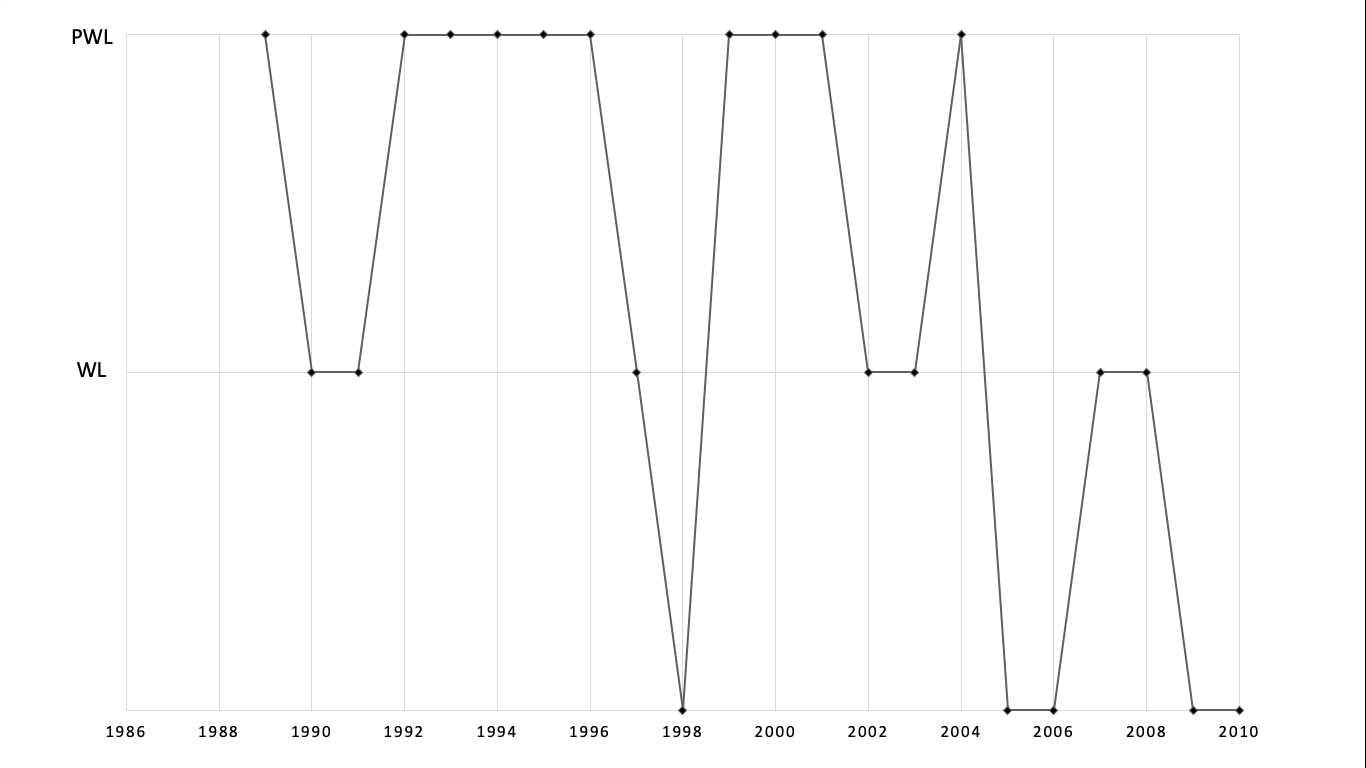
Twenty years under pressure: South Korea’s status under the Special 301 review, 1989–2009. Source: Office of the United States Trade Representative.
How the enforcement was built
Two instruments are worth singling out, because both are unusual.
The first is the reward. Korea does not merely invite consumers to report counterfeits, as many administrations do; it pays them. The scheme is keyed to the value of the goods detected, from one million won where the detected value exceeds 300 million, up to ten million won above 50 billion, capped at two payments or ten million won per person per year, and payable only where the report leads to a referral to the prosecution. A separate scheme pays 50,000 won per reported online listing, up to five a year, and only once the listing has actually been taken down.
The second is the police force. In September 2010 Korea established a special judicial police squad dedicated to trade mark crime — the 상표경찰, the first investigative authority anywhere specialising in counterfeit goods. In March 2019 its jurisdiction was extended to patents, trade secrets and designs. In its first decade it conducted more than 45,000 trade mark investigations and seized over twelve million counterfeit articles worth roughly US$430 million; in 2025 alone it charged 388 people and seized about 143,000 items with a genuine-goods value of 432.6 billion won.
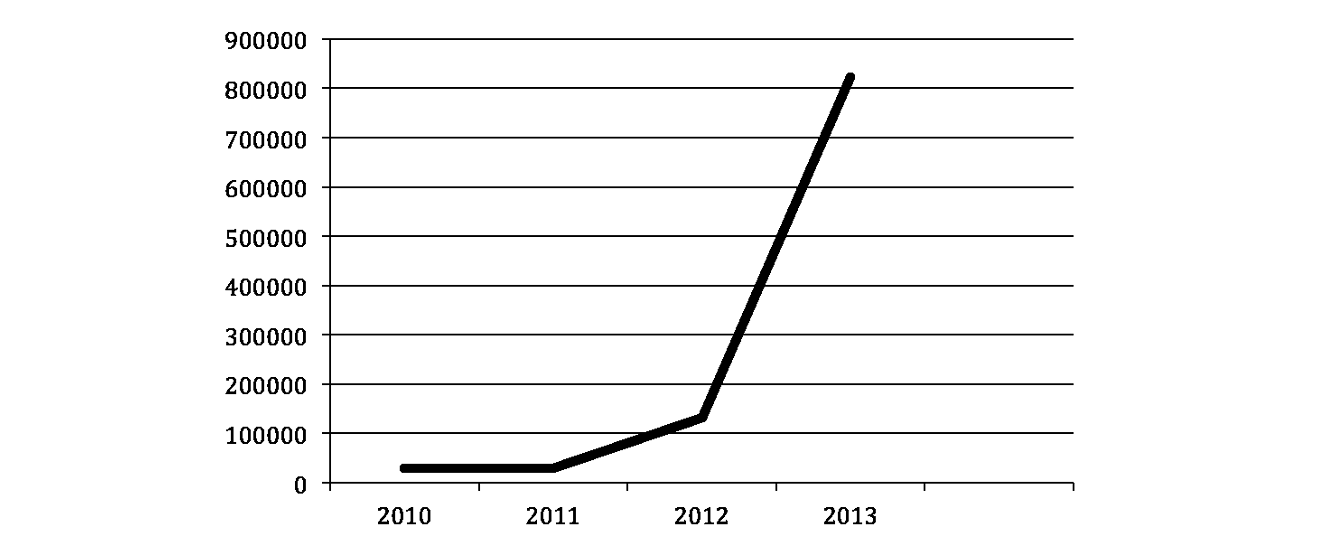
Individuals arrested following the establishment of the special judicial police squad in September 2010. Source: Korean Intellectual Property Office, figures to 2015.
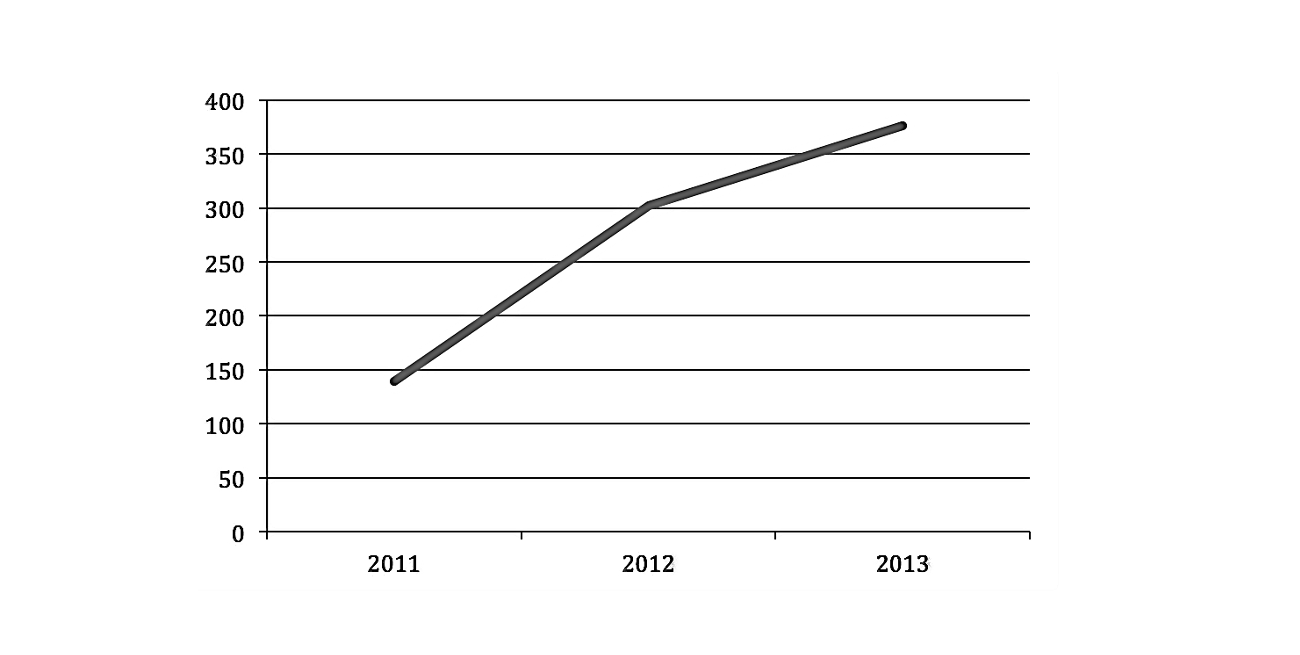
Volume of counterfeit goods seized following the establishment of the squad. Source: Korean Intellectual Property Office, figures to 2015.
A note on the institution: the Korean Intellectual Property Office no longer exists under that name. On 1 October 2025 it was elevated to full ministry status as the Ministry of Intellectual Property (지식재산처).
What Korea became
The arc is worth stating carefully, because the tempting version of it is not quite true.
On the output side the transformation is complete. WIPO’s World Intellectual Property Indicators 2025 puts Korea fourth in the world for patent applications, with 246,245 filings in 2024, and first for patents per head of population, at 3,783 per million — ahead of Japan and Switzerland. The country that was told in 1989 to protect other people’s inventions now files more of its own, per capita, than anywhere else.
On the trade side it is more complicated. Korea’s intellectual-property trade balance ran a deficit from the start of the series in 2010 and has only recently moved into occasional half-yearly surplus. And the component that carried it there was not patents, which remain in deficit, but copyright — cultural content and software. Which is to say that the thing that finally tipped Korea’s intellectual-property balance was the export of Korean culture: music, drama, webtoons and film. The industry, in other words, that made Architecture 101.
Coda
The film was released in 2012 and set in the mid-1990s, and that gap is doing work. It is a film about a country looking back at a version of itself it has left behind — and the counterfeit T-shirt is one of the markers it uses to date the past, in the same register as the cassette player and the pager. A Korean audience in 2012 reads the shirt as a period signal.
For a lawyer it is also a reminder of something the enforcement statistics never show. Seungmin’s shirt cost a trade mark owner almost nothing. What it cost him was the scene.
Principal sources. Case C-291/00, LTJ Diffusion SA v Sadas Vertbaudet SA, judgment of 20 March 2003. Regulation (EU) 2017/1001 on the European Union trade mark, art. 9(2); Regulation (EU) No 608/2013 concerning customs enforcement of intellectual property rights, arts. 1(4) and 2(5)(a). Korean Trademark Act (상표법), arts. 89, 108 and 230; Customs Act (관세법), art. 235. Code de la propriété intellectuelle, arts. L. 716-9 and L. 716-10; proposition de loi no. 172, Sénat, 29 November 2025. Decreto-legge 14 marzo 2005, n. 35, art. 1, comma 7, converted by legge 14 maggio 2005, n. 80 and amended by legge 23 luglio 2009, n. 99.
Office of the United States Trade Representative, Special 301 fact sheet of 25 May 1989; 2009 Special 301 Report, 30 April 2009; 2026 Special 301 Report, 30 April 2026. WIPO, World Intellectual Property Indicators 2025. Ministry of Intellectual Property (지식재산처), formerly the Korean Intellectual Property Office.
On counterfeit consumption. Boonghee Yoo & Seung-Hee Lee, The Buyers of Counterfeit Products in South Korea, 3 Journal of International Business and Law (2004), art. 6 — open access. Young Jee Han, Joseph C. Nunes & Xavier Drèze, Signaling Status with Luxury Goods: The Role of Brand Prominence, 74 Journal of Marketing 15 (2010), circulated as First Impressions: Status Signaling Using Brand Prominence, SSRN. Martin Eisend, Patrick Hartmann & Vanessa Apaolaza, Who Buys Counterfeit Luxury Brands? A Meta-Analytic Synthesis of Consumers in Developing and Developed Markets, 25 Journal of International Marketing 89 (2017). Sameeullah Khan, Asif Iqbal Fazili & Irfan Bashir, Counterfeit luxury consumption: A review and research agenda, 20 Journal of Consumer Behaviour 337 (2021). EUIPO, European Citizens and Intellectual Property: Perception, Awareness and Behaviour (2023).
On Korean counterfeiting networks. Sam Cocks, The Hoods Who Move the Goods: An Examination of the Booming International Trade in Counterfeit Luxury Goods and an Assessment of the American Efforts to Curtail Its Proliferation, 17 Fordham Intellectual Property, Media & Entertainment Law Journal 501 (2006) — open access. On “Operation Pipeline”, see Riskless crime?, Forbes, 11 August 1997.